A uPVC door that will not lock is almost always a mechanism or alignment fault, not a dead door. The five usual causes are a dropped door, a failed gearbox, worn cylinder, loose handle, or a hook or bolt not engaging. A couple are a quick DIY adjustment; the rest need a locksmith, but nearly all are far cheaper than a new door.
Short answer: A uPVC door that will not lock is almost always a mechanism or alignment fault, not a dead door. The five usual causes are a dropped door, a failed gearbox, worn cylinder, loose handle, or a hook or bolt not engaging. A couple are a quick DIY adjustment; the rest need a locksmith, but nearly all are far cheaper than a new door.
It is one of the most common calls we get: "my uPVC door won't lock." If you are in Dudley or anywhere across the West Midlands and need a locksmith, that call is familiar territory for us. People often fear the worst and start pricing up a whole new door. In reality, the vast majority of these are a fault in the locking mechanism or the door's alignment, and most are fixed in a single visit. Here are the five usual suspects.
1. The door has dropped (very common)
uPVC doors are heavy and the hinges take the strain over time, so the door sinks a few millimetres on the hinge side. The hooks and bolts then no longer line up with the keeps in the frame, and you find yourself lifting or leaning on the door to get the handle up. Often adjustable: the hinges can be tweaked to bring the door back into line. If lifting the door makes it lock, this is almost certainly your problem.
2. A failed multipoint gearbox
The gearbox is the heart of the mechanism, the part the handle and key drive. When it fails, the handle may spin loosely, feel notchy, or lift but not throw the bolts. Locksmith job: the strip of mechanism in the door edge is replaced. This is the single most common uPVC repair, and stocking the right gearbox is most of the skill.
3. A worn or seized cylinder
If the key will not turn, turns roughly, or the handle works but the key does not, the cylinder may be worn. Locksmith job, and a good moment to upgrade to an anti-snap cylinder while the door is open.
4. A loose or sagging handle
A handle that has gone floppy or wobbly puts strain on the gearbox and is often the warning sign before a full failure. Sometimes it is just two screws that have worked loose. Sometimes DIY, sometimes more: tighten the through-fixing screws gently, but if the handle still sags, the spring or gearbox behind it is going.
5. A hook or bolt not engaging
If most of the mechanism works but the door still feels insecure, a single hook, roller or deadbolt may not be seating into its keep, usually because of alignment or a worn keep. Usually a locksmith adjustment.
The trap is forcing it. If the handle is stiff, do not heave on it, as you can snap the gearbox and turn a small repair into a bigger one. A door that is getting harder to lock is asking for attention before it fails completely.
What you can safely try
Before calling out, it is fine to: lift the door slightly on the handle to see if it then locks (points to a drop), gently tighten visibly loose handle screws, and lightly lubricate the cylinder with a proper lock lubricant. What you should not do is force a stiff mechanism or take the handle off if you are unsure, as the spindle and gearbox are easy to damage.
If it is not a simple adjustment, a locksmith will diagnose the exact part and usually fix it on the first visit. Doctor Locks repairs uPVC doors across the West Midlands, including Quinton, Rubery and Dudley.
What the repair actually involves on the doorstep
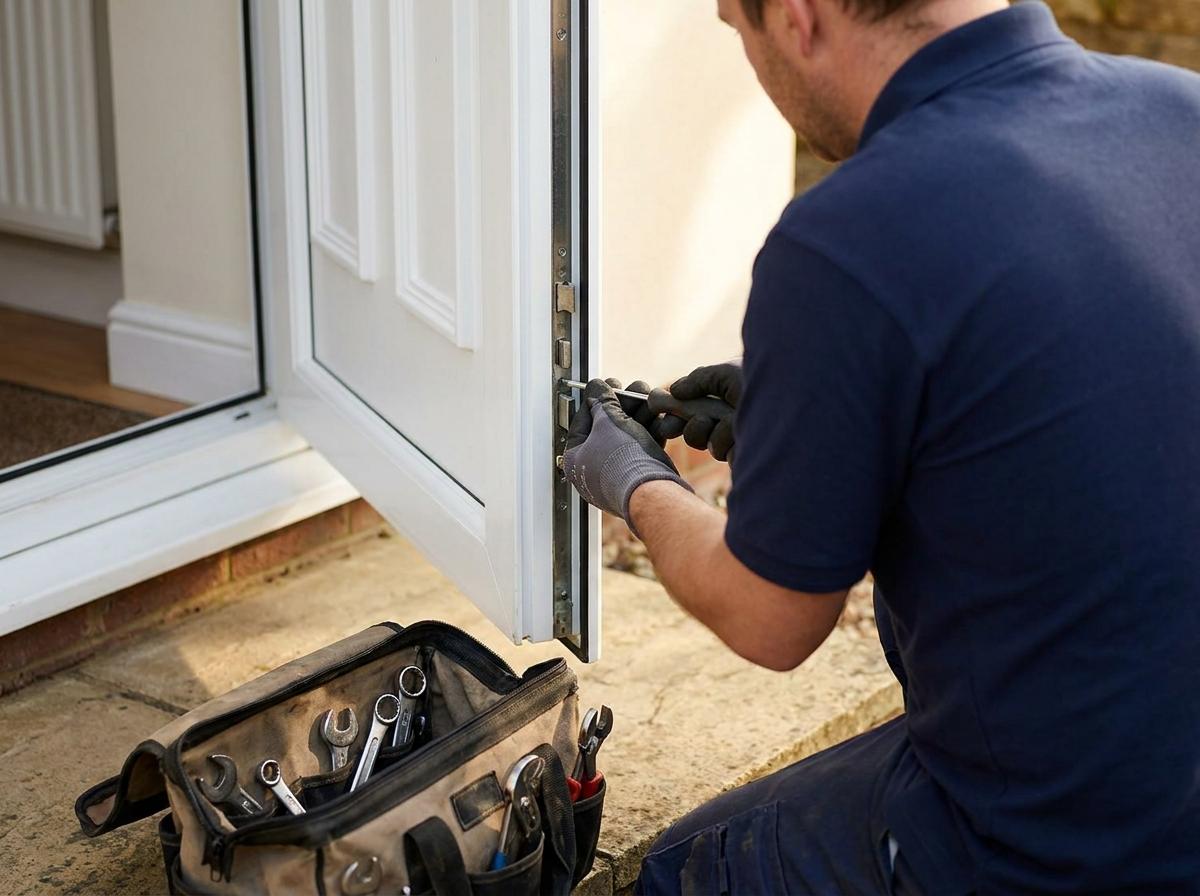
People often ask what a locksmith actually does when they arrive, so it is worth being honest about it. The first thing I do is watch the door in use: how the handle feels, whether there is visible movement between the door and frame, and whether the door sits flush or stands proud at the top or bottom. That thirty-second look usually tells me most of what I need to know before I open a toolbox.
If the door has dropped, I will check each hinge in turn. Modern uPVC hinges have adjustment points, usually accessible with a hex key, that let you move the door up, down, in and out by a few millimetres. The aim is to get the door sitting square in the frame so that every hook and bolt lines up with its keep. You can hear and feel when it is right: the handle lifts smoothly and all the points engage without resistance.
If the gearbox has failed, the strip of mechanism runs the full height of the door edge, held in by a series of screws. Removing it is straightforward once you know what you are doing, but the important part is identifying the correct replacement. Gearboxes are not universal. The backset (the distance from the edge of the door to the centre of the cylinder hole), the size of the case, the direction of the cam, and the positions of the hook and bolt outputs all have to match. Fitting the wrong one means the door will not lock correctly even with a brand new part. This is why carrying a good range of stock matters, and why I keep a selection of the most common types in the van rather than ordering after the visit.
For a cylinder replacement, the process is quicker: one screw in the faceplate releases the cylinder, and it slides out once the key is turned to the release position. The new cylinder goes in and the door is locked and unlocked several times to confirm it is all working before I leave. If the door is already open when I arrive and the mechanism has seized, there is occasionally a little more work involved in releasing the bolts manually, but that is rarely a lengthy job.
How to tell which fault you actually have
The symptoms can overlap, so here is a practical way to think through it before you call.
- If lifting the door body lets you lock it, the door has dropped. The mechanism itself is fine. Start with hinge adjustment.
- If the handle turns but nothing happens, or the handle spins freely with no resistance, the gearbox has gone. The cylinder and alignment are not the issue.
- If the handle works but the key does not, or the key is stiff and gritty, the cylinder is worn or dry. Try a small amount of lock lubricant first, not WD-40, which dries out and makes it worse over time.
- If the handle feels floppy at rest but still operates the mechanism, the return spring inside the gearbox is weakening. The mechanism may still lock for now, but it is likely to fail soon.
- If the handle lifts fine but the door still does not feel secure, one or more of the hooks or bolts is not seating. Look at the keeps in the frame to see if there is a mark where the bolt is hitting rather than entering cleanly.
Running through this takes a couple of minutes and usually narrows it down to one fault. If you are still unsure, describing the symptoms when you call means a locksmith in Dudley or nearby can come prepared with the most likely parts rather than having to make a second trip.
What happens if you leave it
A door that is getting difficult to lock is not just an inconvenience; it is a security problem that tends to get worse rather than better on its own. A gearbox that is on its way out will eventually reach a point where the door cannot be locked at all, sometimes at the least convenient moment, last thing at night or when you are about to leave for work. A dropped door, if left long enough, starts to wear the frame keep unevenly and can eventually damage the frame itself, which is a harder repair than simply adjusting the hinge.
There is also the question of security while the door is unreliable. A mechanism that only half-engages, or a hook that is not fully seating, means the door is not giving you the protection it should. If this is your front door, it is worth treating it as urgent rather than something to get round to. Our emergency locksmith service covers situations where a door has failed completely and cannot be secured, but catching a fault early almost always means a simpler and less disruptive repair.
FAQ
Do I need a new door if my uPVC door will not lock?
Almost never. The large majority of these faults are in the mechanism or alignment and are repaired in a single visit for a fraction of the cost of a new door.
Why do I have to lift the handle hard to lock my door?
That is the classic sign of a dropped door. The hooks no longer line up with the frame keeps, so you compensate by lifting. The hinges can usually be adjusted to bring it back into alignment.
Can you fix the door the same day?
Usually, yes. We carry common gearboxes, cylinders and parts, so most uPVC repairs are completed on the first visit.
Is WD-40 suitable for lubricating a uPVC door lock?
No. WD-40 is a water displacer rather than a long-term lubricant, and it leaves a residue that attracts dirt and can make the mechanism feel worse over time. Use a dedicated lock lubricant, either a dry graphite spray or a PTFE-based product, applied sparingly into the keyway and along the faceplate of the mechanism.
My door locks from the inside but not with the key from outside. What does that mean?
This points strongly to the cylinder rather than the gearbox. The handle and its connection to the mechanism are working, but the cylinder is worn or damaged enough that it can no longer drive the cam reliably. A cylinder replacement should resolve it, and it is a good opportunity to fit an anti-snap cylinder if you do not already have one.
Related guides and pages
Need a locksmith now?
Doctor Locks aims to reach you within the hour across Birmingham and the West Midlands. Read more about uPVC Door Lock Repairs.
Frequently asked questions
Do I need a new door if my uPVC door will not lock?+
Almost never. The large majority of these faults are in the mechanism or alignment and are repaired in a single visit for a fraction of the cost of a new door.
Why do I have to lift the handle hard to lock my door?+
That is the classic sign of a dropped door. The hooks no longer line up with the frame keeps, so you compensate by lifting. The hinges can usually be adjusted to bring it back into alignment.
Can you fix the door the same day?+
Usually, yes. We carry common gearboxes, cylinders and parts, so most uPVC repairs are completed on the first visit.
Jason has been a locksmith since 1999 and runs Doctor Locks personally, attending jobs across Birmingham and the wider West Midlands. Every article here is written from real work on real doors, not theory.